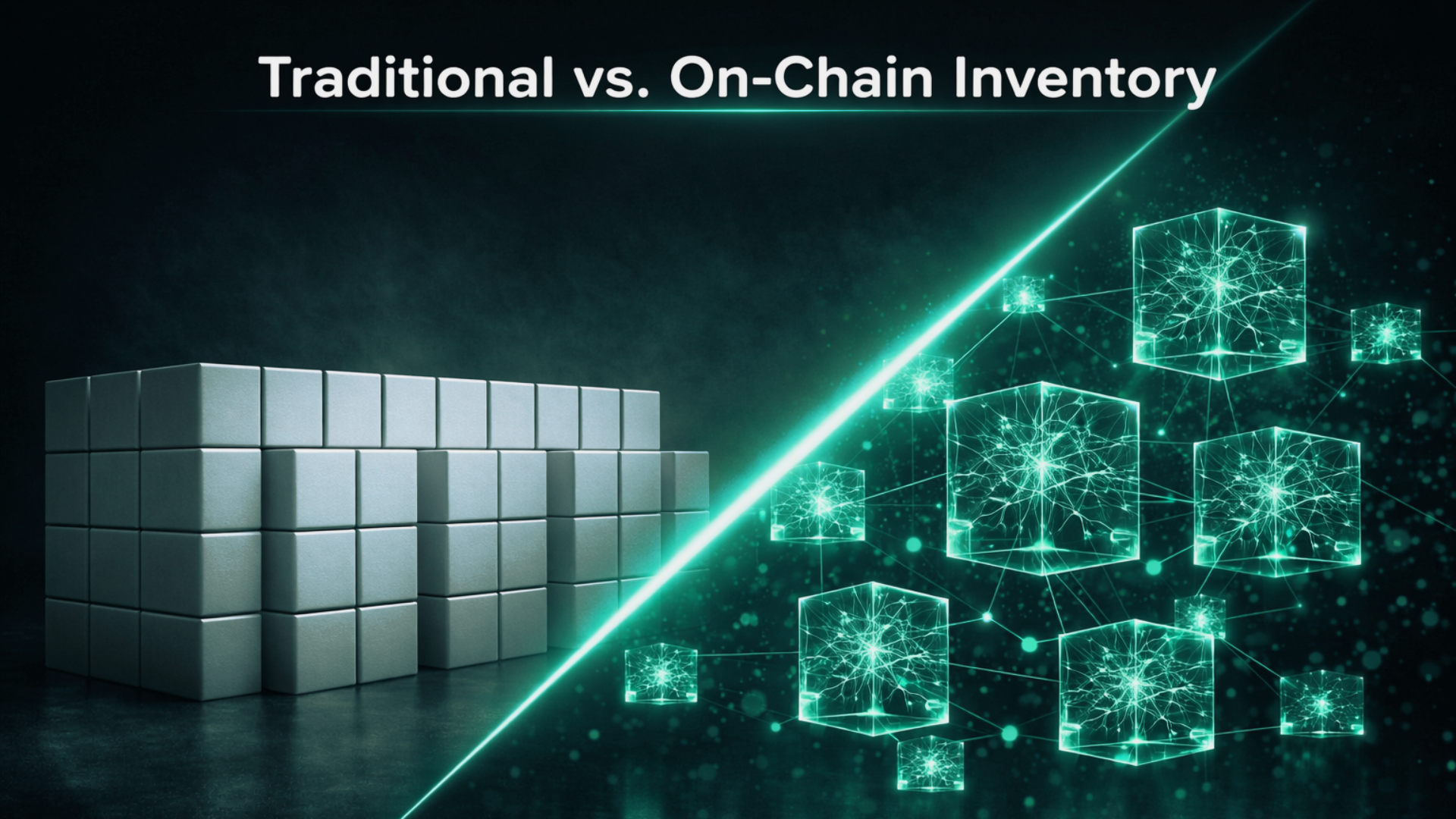
Managing inventory used to be about defense. You just wanted to stop people from stealing it and hope you didn't buy too much of the wrong thing.
But for brands dealing with physical goods—fashion, electronics, luxury—the old way of doing things is breaking down.
Right now, the retail industry loses about $1.73 trillion a year because of inventory issues. That’s the cost of either having too much stock that won't sell, or running out of the stuff people actually want. It’s a mess, and it eats up about 6.5% of global sales.
So, as we look at where commerce is going, the question for a CFO isn't "Is blockchain cool?"
The question is simple: Does moving my inventory onchain give me a better ROI than keeping it in a traditional database?
We looked at the data. Here is the breakdown of Traditional Inventory vs. the droplinked Merchant InventoryOS.
1. The Cost of Being Everywhere (and Nowhere)
Here’s the problem with most modern brands: You have too many tools. You have a Shopify store, maybe an Amazon listing, a warehouse system, and a marketing dashboard.
None of them talk to each other properly.
This is the "Fragmentation Tax." When your Shopify store thinks you have 10 units, but your warehouse actually has 0, you oversell. That kills your customer trust. If you sell on Amazon and run out of stock for just three days, their algorithm punishes you, and your search ranking can drop by 83%.
The Onchain Fix: With droplinked, we create a "Single Source of Truth."
We tokenize the inventory. That sounds technical, but it just means the official record of your product lives on a public ledger, not in a siloed database. Everyone—your store, your affiliates, your warehouse—sees the exact same number in real-time. No syncing delays. No "glue code" to fix APIs.
The Result: Brands using unified systems usually drop their operating costs by 22% and see sales go up by 8.9% just because they actually have the product when the customer wants it.
2. Turning Dead Stock into Cash
In the traditional world, inventory is a liability. It sits on a shelf and loses value until someone buys it. Once they buy it, your relationship with that item ends.
If a customer resells your limited-edition sneaker on StockX for double the price, you get $0.
The Onchain Fix: When you put inventory onchain, it becomes a Real-World Asset (RWA). This changes the math.
Smart contracts let you build royalties right into the product. Nike figured this out early. They made over $92 million just from royalties on secondary transactions.
You don't have to be Nike to do this. With droplinked, you can set a 5-10% royalty. Now, every time your product changes hands on the secondary market, you get paid. You turn a one-time sale into recurring revenue without manufacturing a single new item.
3. Stop Paying for Fake Traffic
If you pay influencers or affiliates, you know the struggle. Attribution is messy. Apple’s iOS updates blocked cookies, and ad-blockers hide the rest.
Worse, there is a lot of fraud. About 17% of affiliate traffic is fake—bots, click farms, or cookie stuffing. You are paying commissions for sales that didn't actually happen the way you thought.
The Onchain Fix: We don't use cookies. We use smart contracts.
When an affiliate sells your product on droplinked, the transaction happens onchain. The smart contract sees the money come in, and it instantly splits it. You get your funds, and the affiliate gets their cut.
It’s math, not an estimate. You stop losing 30% of your budget to fraud and only pay for verified sales.
4. Financing That Doesn't Hurt
If you grow fast, you run into a cash flow problem. You have to pay your factory months before you sell the goods.
To bridge the gap, a lot of brands take Merchant Cash Advances (MCAs). They are fast, but they are expensive. When you do the math on the fees, the effective interest rate (APR) is often 80% to 150%. That destroys your margins.
The Onchain Fix: Onchain sales history is verifiable. You can’t fake it. Because lenders can trust the data, they can offer you better rates.
On droplinked, you can access financing based on your real performance. Instead of paying triple-digit interest rates to a predatory lender, onchain financing (DeFi) rates are often closer to 12–18%.
5. The Compliance Headache
New laws are coming. The EU is rolling out the "Digital Product Passport" (DPP). Soon, you will be legally required to track where your materials came from and how recyclable your product is.
Building a custom database to track all this is expensive. For electronics brands in Europe, it’s costing millions.
The Onchain Fix: This is native to us. Every item on droplinked gets a Digital Product Passport by default. The history is transparent and creates a QR code customers can scan. You get compliant without building a massive tech stack from scratch.
The Bottom Line
Here is the head-to-head comparison:
The industry is shifting. We are moving from "Passive Inventory" (boxes sitting in the dark) to "Agentic Inventory"—products that can verify themselves, pay their own affiliates, and sell globally without friction.
The risk isn't trying something new. The risk is staying stuck with an expensive, slow system while your competitors move onchain.
Unbind your commerce. Start building your Merchant InventoryOS on droplinked today.
Category
Educational Content
Published
Feb 19, 2026
Share
In this article
1. The Cost of Being Everywhere (and Nowhere)
2. Turning Dead Stock into Cash
3. Stop Paying for Fake Traffic
4. Financing That Doesn't Hurt
5. The Compliance Headache
The Bottom Line
Tags